A truly non-toxic rug is made of natural fiber, colored with plant or mineral dyes (or left undyed), and has no synthetic latex backing and no glue holding it together. At a real organic rug store, you can check every one of those things with your own hands and get a straight answer about where the rug was made.
At Organic Looms, our showroom sits at 68th Street and Thomas Road in the Scottsdale Design District, about 15 to 20 minutes from Arcadia and the Biltmore area. To have a few rugs pulled before you visit, reach out to our team or call (480) 947-4822.
What makes a rug truly non-toxic?
It comes down to fiber and dye. Wool, organic cotton, silk, hemp, jute, and linen are all natural. Polyester, nylon, and polypropylene are not, however soft they feel on the showroom floor.
This matters more in Phoenix than in most places. From late spring into fall, most of us keep the house shut and the AC running. Anything a rug releases into the air has nowhere to go.
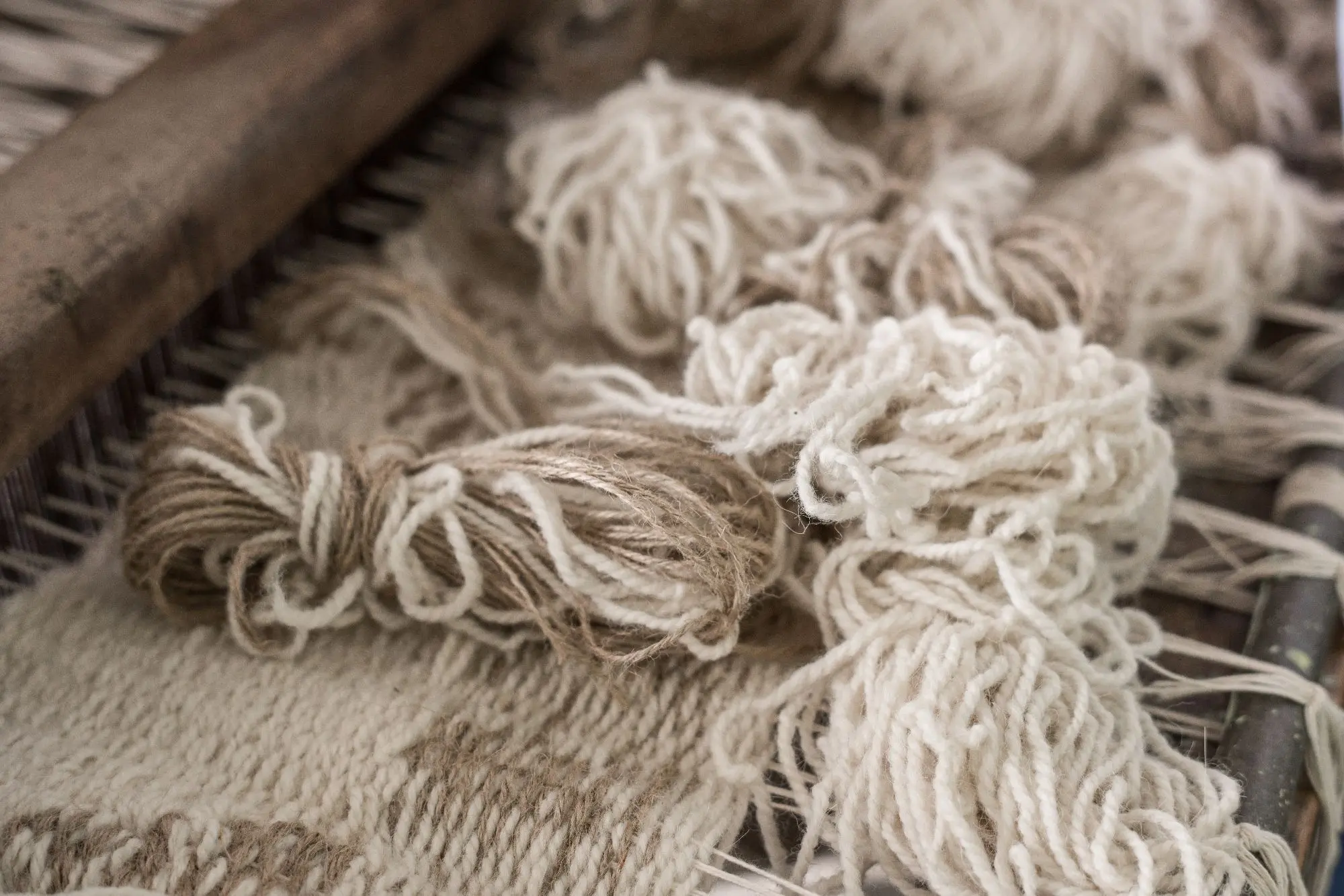
Wool is the fiber we recommend most for Phoenix homes. Ours comes from sheep raised on organic pastures without synthetic hormones or antibiotics, and the fleece is hand-washed and hand-spun. It also holds up well after a monsoon dust storm leaves fine grit across the floor.
For color, look for plant-based and mineral-derived dyes. Undyed wool, in its natural creams, grays, and browns, is the simplest option of all. You can see both in our collection of organic non-toxic rugs.
Why does the backing matter more than the label?
Because the backing is where most of the chemicals hide. A rug can be all wool on top and still be glued to a synthetic latex backing underneath. That is usually the part that smells when the rug comes out of the plastic.
Many machine-made and hand-tufted rugs are built this way. Yarn is punched through a cloth base, a latex adhesive locks it in place, and a second cloth gets glued over the back. The tag on the front says wool. The back tells you the rest.
Our rugs are free from synthetic latex backings. A hand-knotted rug does not need glue at all, because every knot is tied around the warp threads that form the rug's own foundation. In our hand-knotted pieces, organic cotton often does that structural job.
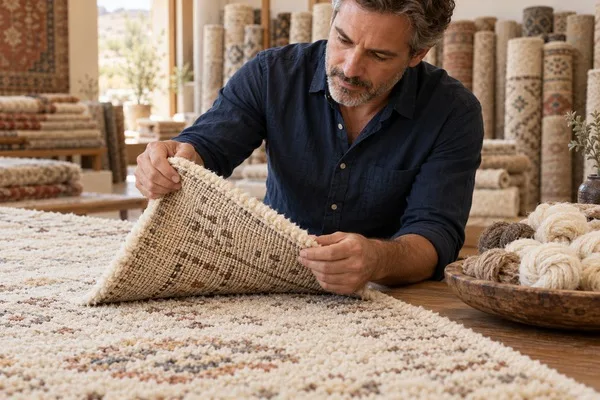
So turn the rug over. A plain canvas or felt layer, or a sharp chemical smell, means you should ask exactly what that layer is. Ask about the rug pad too, since a synthetic pad can undo the point of a natural rug.
How can you tell a hand-knotted rug from a tufted one?
Flip it over. On a hand-knotted rug, the pattern shows clearly on the back and you can see rows of individual knots. On a tufted rug, a layer of cloth covers the back, so you see no pattern at all.
Check the fringe next. On a hand-knotted rug, the fringe is the end of the warp threads that run the full length of the piece. On many machine-made rugs, it is sewn on afterward as trim.
Small irregularities are a good sign. A slightly uneven edge, or soft bands of color across the field (rug makers call it abrash), come from hand-spun yarn and natural dyes taking color unevenly.
Our rugs are hand-knotted by artisans with no machinery, from fiber that is combed and spun by hand. That takes far longer than tufting and costs more. It is also why there is nothing to glue.
What questions should you ask at an organic rug store?
Ask questions that need a specific answer. Words like "natural" or "eco friendly" cost nothing to print on a tag. A good organic rug store can go further.
Start here. What is the face fiber, and what is the foundation made of? Which dyes were used, or is the wool undyed? Is there any latex, glue, or synthetic backing? Was it hand-knotted, hand-tufted, or machine-made? Where was it woven, and by whom?
That last one separates real sourcing from a marketing story. We buy hand-knotted rugs directly from weavers in India, Pakistan, Afghanistan, and Morocco, with no importer in between. Most of the workshops are around Jaipur and Bhadohi, and we travel there to check on conditions ourselves.
If a seller cannot say where a rug came from, take that as your answer. To see how we help homeowners across the Valley, from Arcadia to Desert Ridge, visit our page on area rugs in Phoenix.
Why see a non-toxic rug in person before you buy?
Because the proof is in things you touch, smell, and turn over. A product photo will never show you the back of a rug.
A customer came in recently looking for a gift for someone who was very particular about how they live. This person ate only organic food, had a serious water filtration system at home, and avoided toxins whenever they could.
We were more than happy to walk through the fibers and the sourcing of each material with them, rug by rug, so they could choose a gift that truly fit that lifestyle.
Short on time? Ask about our complimentary in-home preview, where we bring several rugs to your house so you can see them in your own light, with no obligation. Delivery is free throughout the Phoenix metro.
The showroom is open Monday through Friday, 9:00am to 5:00pm, with weekends by appointment. Come see our natural, non-toxic rug collection in person, or contact Organic Looms at (480) 947-4822 to set up your visit.